 General 10AM-7PM (Mon-Sat)

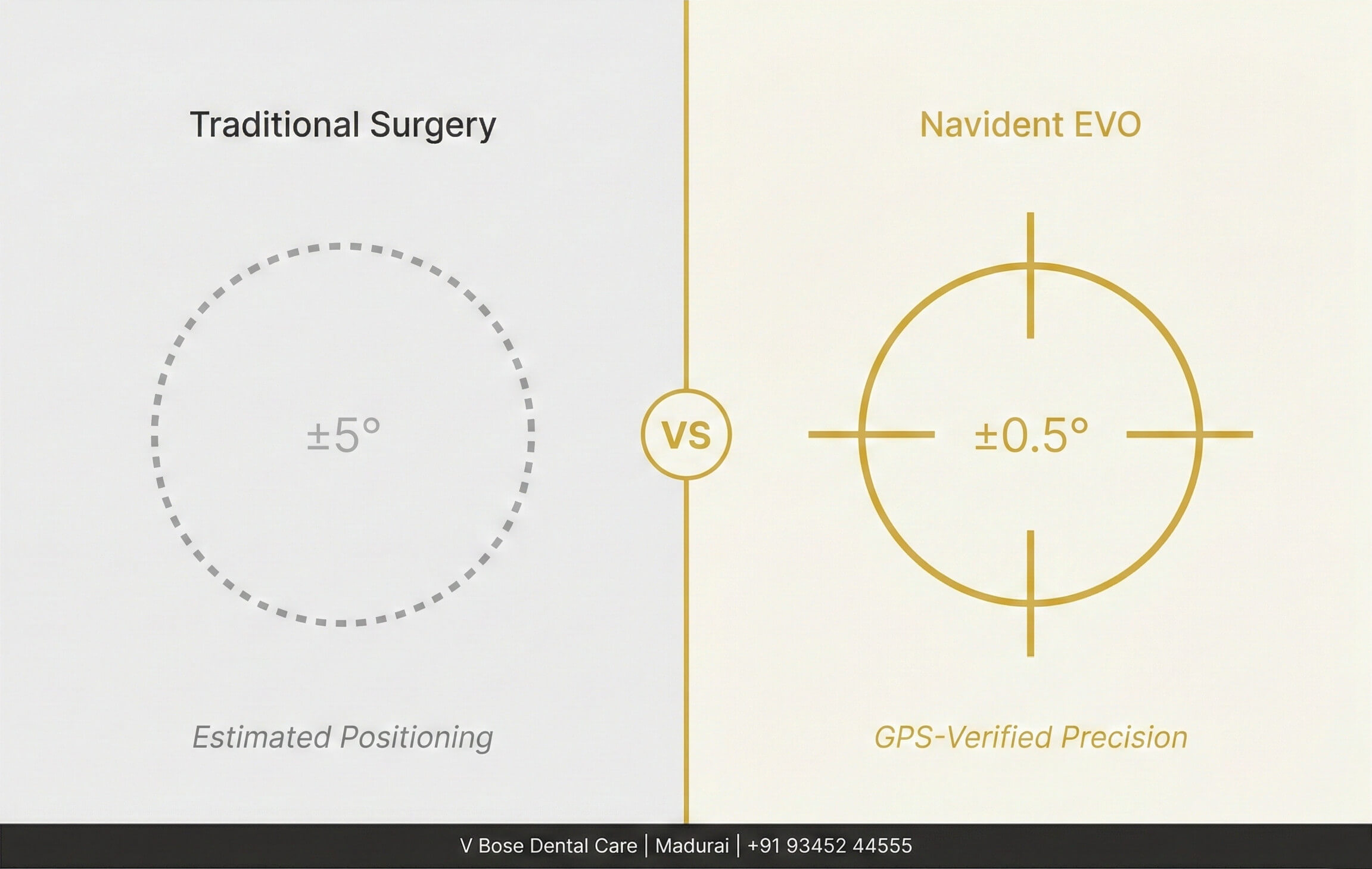
Computer Guided Dental Implants in Madurai: Why Navident EVO Navigation Delivers Better Results Than Traditional Surgery
If you’re comparing dental implant options in Madurai—or traveling from elsewhere in Tamil Nadu to find the best available care—this article cuts through the marketing language to give you an honest, evidence-based answer to the question that actually matters:
Does computer-guided implant surgery produce better results than traditional surgery, and is it worth seeking out?
The short answer: yes, specifically when it matters most. Here is the detailed version.
What “Computer Guided Implants” Actually Means
The phrase “computer guided implant surgery” is used loosely in dental marketing, covering a spectrum of approaches with significantly different clinical implications.
Level 1: Basic CBCT Planning (Not Guided Surgery)
Many clinics claim “computer guided” treatment simply because they use CBCT 3D imaging for diagnosis and planning. This is valuable—3D imaging is far superior to 2D radiographs for implant assessment. But CBCT planning without navigation means the surgeon uses this information to make better freehand decisions. The surgery itself remains unguided.
Level 2: Static Surgical Guides (Partially Guided)
3D-printed stents with channels directing drill angulation at implant entry. Guidance is fixed at the moment of guide fabrication. Cannot adapt during surgery. Provides directional assistance at entry but no continuous feedback during drilling. Accuracy improvement over freehand is real but limited.
Level 3: Dynamic Navigation — Navident EVO (Fully Guided)
Real-time computer guidance throughout every millimeter of drilling. The system continuously tracks instrument position relative to your pre-surgical plan, displaying current position, deviation from plan, and distance to critical structures. The surgeon has complete positional awareness throughout—not just at entry, but continuously from first contact to final depth.
V Bose Dental Care uses Level 3—Navident EVO dynamic navigation. This is the current clinical gold standard for guided implant surgery.
The Results Comparison: Numbers That Matter
Accuracy Comparison (Published Research)
Angular Accuracy at Implant Head:
| Surgical Approach | Mean Angular Deviation |
|---|---|
| Freehand surgery | 4.0 - 8.0 degrees |
| Static guides | 2.0 - 4.0 degrees |
| Dynamic navigation (Navident) | 0.5 - 1.5 degrees |
Depth Accuracy:
| Surgical Approach | Mean Depth Deviation |
|---|---|
| Freehand surgery | 1.0 - 2.0mm |
| Static guides | 0.5 - 1.5mm |
| Dynamic navigation (Navident) | 0.2 - 0.5mm |
What These Numbers Mean in Practice:
For a standard 13mm implant placed at 5 degrees angular error (typical freehand), the implant apex (tip) is positioned approximately 4.5mm from the planned position. At 1 degree deviation (navigation average), the apex is less than 1mm from plan.
In a 7mm-wide alveolar ridge (common in posterior regions), a 4.5mm apex deviation may place the implant outside the bone. A less-than-1mm deviation keeps it safely centered.
Patient Outcome Comparison
Implant Failure Rates:
Navigation-guided surgery demonstrates reduced implant failure rates, particularly in:
- Compromised bone quality cases
- Immediate loading protocols
- Full arch rehabilitation
- Cases in patients with systemic conditions
Prosthetic Complication Rates:
Mispositioned implants create prosthetic challenges:
- Crowns that cannot be made to look natural
- Bridges that cannot seat correctly
- All-on-4 prostheses that require modification or replacement
- Screw access holes in aesthetically unacceptable positions
Navigation-guided placement reduces these complications significantly.
Patient Satisfaction:
Studies consistently show higher patient satisfaction scores with navigation-guided surgery, attributed to:
- Reduced surgical anxiety through plan visualization
- More confident, efficient surgical experience
- Better aesthetic outcomes from precise positioning
- Fewer post-surgical complications requiring additional visits
Real Patient Outcomes at V Bose Dental Care
Case 1: Posterior Lower Implant — Nerve Proximity
Patient: Raman, 52, IT Professional, Chennai
Situation: Single missing lower molar. CBCT showed inferior alveolar nerve unusually high in the jaw—only 6mm of safe bone above the nerve canal at the planned site. Freehand surgery at planned depth risked nerve contact.
Navident EVO Approach: Safety boundary programmed 2mm above nerve canal. Navigation monitored distance throughout drilling. Implant placed precisely at planned depth, 2mm safely above nerve.
Outcome: Perfect integration, zero sensory disturbance, crown delivered 12 weeks later matching adjacent teeth exactly. Raman’s local Chennai dentist who referred him specifically requested the navigation surgery documentation for his records—validating the approach.
Patient: Anitha, 44, Teacher, Madurai
Situation: Upper posterior implants needed bilaterally. Left side had 8mm bone below sinus—adequate but requiring precision. Right side had only 6mm—borderline for standard implants without sinus lift.
Navident EVO Approach: Left side implant guided to 7.5mm depth precisely (0.5mm safety margin above sinus). Right side anatomy evaluated intraoperatively with navigation—sufficient bone density allowed 6mm implant placement with navigation confirming sinus clearance throughout.
Outcome: Both implants integrated perfectly. Right-side sinus lift avoided through navigation-enabled precise placement. Patient avoided additional surgery and 4-6 months additional healing time.
Case 2: All-on-4 Full Arch Rehabilitation
Patient: Subramaniam, 67, Retired Officer, Madurai
Situation: Complete lower arch edentulous, requiring All-on-4 immediate loading (same-day teeth). Four implants planned—two anterior vertical, two posterior 30-degree angulated. Pre-fabricated temporary prosthesis ready for same-day placement.
Navident EVO Approach: All four implants planned collectively in Navident to precise coordinates and angles. Navigation guided each implant to exact planned position. Posterior implants achieved planned 30-degree angulation to within 0.8 degrees of plan.
Outcome: Temporary prosthesis seated perfectly on surgery day. Subramaniam left with functional teeth the same afternoon as implant placement. Final prosthesis delivered 6 months later. Now 18 months post-surgery, all four implants stable with maintained bone levels.
Case 3: Aesthetic Zone Anterior Implant
Patient: Divya, 29, Marketing Executive, Coimbatore
Situation: Upper central incisor lost to trauma. Most visible implant position—any deviation in angulation or depth creates visible aesthetic compromise in the final crown.
Navident EVO Approach: Implant position planned to achieve ideal emergence profile for the crown. Navigation guided placement to exact planned depth and angle. iTero Lumina scan post-integration provided precise digital impression for crown fabrication.
Outcome: Crown aesthetically indistinguishable from adjacent natural teeth. Divya—who traveled from Coimbatore specifically for navigation-guided surgery—described the result as “worth every kilometer of travel.”
Case 4: International Patient, Multiple Implants
Patient: Pradeep, 48, UK Resident (NRI)
Situation: Five missing teeth across upper arch, returning to India for dental care during annual visit. Limited 10-day window. Required multiple implants with maximum efficiency.
Navident EVO Approach: All five implants planned collectively. Three placed in single surgery session using navigation—precise coordination without the extended surgical time required for repeated freehand measurement. iTero Lumina captured digital impressions for temporaries.
Outcome: Three implants placed in a 2.5-hour surgery. Temporaries delivered before Pradeep returned to UK. Final restorations completed during next annual visit. Complete treatment without extending India stay—enabled by navigation surgery efficiency.
Why Patients Travel From Across Tamil Nadu for Navident Surgery
The Scarcity Factor
Dynamic navigation implant surgery using systems like Navident EVO is genuinely rare in Tamil Nadu. Most implant surgery—including in large Chennai clinics—is performed freehand or with static guides. True real-time navigation represents a minority of implant surgery volume across India.
Patients who research this distinction travel to access it. The travel calculation is straightforward: for a treatment that will last decades, the quality difference justifies the journey.
From Chennai (6-7 hours or 45-minute flight): Large city, many implant options, but navigation surgery of Navident’s specification is not widely available even in specialist practices. Patients who research and find V Bose Dental Care make the journey for verified precision.
From Coimbatore (4-5 hours): Tamil Nadu’s second city has competent dental care. For navigation-guided implant surgery, patients research and find Madurai’s V Bose Dental Care as the accessible option.
From Trichy, Dindigul, Sivagangai, Theni, Virudhunagar: Regional patients within 1-2.5 hours find navigation surgery accessible without significant travel burden.
From International Locations: NRI patients returning to Tamil Nadu who research implant options globally often find V Bose Dental Care’s navigation capability matching or exceeding what they access abroad at dramatically lower cost.
Honest Comparison: When Navigation Provides Maximum vs Minimal Additional Benefit
Navigation Provides Maximum Benefit:
Complex Anatomy Cases: Near-nerve, near-sinus, narrow ridges—cases where freehand surgery carries measurable risk that navigation eliminates through continuous monitoring.
Multiple Implant Cases: Coordination of 4-6 implants for full arch rehabilitation requires precision impossible to achieve through experience alone.
Immediate Loading Cases: Same-day teeth require implants in exact planned positions. Navigation verifies this in real time.
Aesthetics-Critical Cases: Anterior implants where angular precision directly determines crown aesthetics.
Anxious Patients: Plan visualization and navigation confidence transforms the surgery experience.
International Patients: Cannot easily return for complications. Navigation reduces this risk.
Navigation Provides Modest Additional Benefit:
Simple Single Implants in Ideal Anatomy: Abundant bone, far from critical structures, experienced surgeon. Freehand results may be comparable. Navigation still provides verifiable precision and documented positioning.
Experienced Surgeon in Routine Cases: Dr. Bose’s 20+ years of experience means excellent freehand results in straightforward cases. Navigation adds documentation and the safety of verification.
The Honest Bottom Line:
Navigation surgery is more valuable in complex cases. In simple cases, excellent outcomes are achievable without it. Dr. Bose will tell you honestly which category your case falls into—and recommend the approach providing genuinely optimal outcomes for your specific situation, not the most expensive option.
Cost Analysis: Investment vs. Value
Direct Cost Comparison
Navigation-guided surgery represents a premium over freehand approaches, reflecting:
- Significant capital investment in Navident EVO system
- Specialized training requirements
- Calibration and maintenance
- Enhanced planning time
V Bose Dental Care’s Approach: Navigation fees are incorporated into treatment costs transparently. Dr. Bose discusses cost implications honestly during consultation, explaining the value case for navigation in your specific situation.
The True Cost of Complications
Implant complications from malpositioning create costs that frequently exceed the navigation premium:
Implant Removal and Replacement: Failed or malpositioned implants require removal (complex surgery), healing period (3-6 months), and re-implantation. Total additional cost significantly exceeds navigation fee.
Prosthetic Complications: Crowns and bridges that don’t fit due to implant malpositioning require remake with laboratory and clinical fees.
Nerve Injury Management: Post-surgical nerve injury may require specialist consultation, medication management, and in severe cases, surgical intervention.
Repeat Surgery: Any surgical revision carries clinical risk, additional recovery time, and cost.
The Prevention Premium:
When navigation prevents a single significant complication, its cost is recovered many times over. For patients traveling internationally, complications are more than financial—they require unplanned return visits disrupting life and work.
Comparing to International Costs
For international patients and NRI patients, V Bose Dental Care’s navigation-guided implants represent exceptional value:
- Navigation-guided single implant: 60-70% savings vs. UK/USA equivalents
- Navigation-guided All-on-4: Comparable savings on major treatment
- Same technology standard as international navigation centers
- Dr. Bose’s personal involvement exceeding most specialist clinics
For complete pricing transparency, visit our comprehensive pricing guide.
Dr. Vinod Bose: The Surgeon Behind the Navigation
Technology performs precisely as well as the surgeon using it. Understanding Dr. Bose’s qualifications contextualizes what Navident EVO delivers in his hands.
Qualifications and Training
Academic:
- Master of Dental Surgery (MDS)
- Advanced Orthodontics and Dentofacial Orthopedics
International Specialty Training:
- Implantology Certification, United Kingdom
- Laser Dentistry Certification, Italy
- Chiropractic Dentistry Specialization
Technology Certification:
- Navident EVO Navigation Surgery Certification
- iTero Lumina Certification
- CS 9600 CBCT Advanced Imaging
Experience:
- 20+ years clinical practice
- Hundreds of implant surgeries
- Established international patient practice
- Founded V Bose Dental Care 2004
The Personal Involvement Principle
At V Bose Dental Care, every navigation surgery is performed by Dr. Vinod Bose personally. No residents. No associates. No delegation of complex surgical phases.
This personal involvement means:
- The surgeon planning your case is the surgeon performing it
- Continuity of knowledge from CBCT review through surgical execution
- Accountability and ownership of every outcome
- Direct communication at every stage
For patients accustomed to hospital systems where consultants plan and residents execute, V Bose Dental Care’s model is genuinely different—and genuinely better for complex surgical cases.
The V Bose Dental Care Technology Combination
Why Both iTero and Navident Matter for Implant Cases
Complete implant treatment requires two technology phases:
Phase 1: Surgical Placement (Navident EVO) Precise implant positioning guided to submillimeter accuracy. Critical structures protected. Plan verified intraoperatively.
Phase 2: Prosthetic Restoration (iTero Lumina) After osseointegration, iTero Lumina captures precise digital impressions for implant crown fabrication. The 6-micron accuracy of iTero ensures crown-to-implant interface precision matching the surgical precision of Navident-guided placement.
The Combined Outcome: Navigation places the implant exactly where planned. Digital impressions capture the implant position exactly. The laboratory fabricates the crown to exact specifications. The result fits first time.
This integrated workflow—surgical navigation to digital impression to precise restoration—is the complete digital implant pathway at V Bose Dental Care.
Additional Supporting Technology
CS 9600 3D CBCT: Premium imaging providing the data Navident requires for precise planning. Image quality directly influences planning precision.
Laser Systems: Soft tissue management enhancing surgical precision and healing response.
Premium Implant Systems: Osstem and Straumann implants—not budget alternatives—matched with navigation precision for optimal biological and mechanical outcomes.
Class B Sterilization: Hospital-grade infection control protecting every implant surgery from contamination risk.
Making Your Implant Decision
Questions to Ask Any Implant Provider
Before choosing where to have your implants placed, ask these specific questions:
1. “What guidance system do you use for implant placement?” Acceptable answers: Dynamic navigation (Navident, X-Guide, or equivalent), or honest “we perform freehand surgery” with detailed explanation of experience and outcomes. Concerning answers: “computer guided” without specifics, or “we use guides” without clarifying static vs. dynamic.
2. “Can I see my surgical plan before the procedure?” Navigation allows this. Freehand surgery cannot provide pre-surgical positional plan review. This question reveals the technology level immediately.
3. “Who performs the surgery—the same doctor I consult with?” Personal involvement matters. Know who holds the drill.
4. “What implant brands do you use and why?” Look for globally validated systems (Osstem, Straumann, Nobel, Zimmer). Understand why the specific system is recommended for your case.
5. “What documentation do I receive after surgery?” Navigation surgery provides verifiable position documentation. Freehand surgery cannot. Post-surgical documentation is a navigation marker.
What Choosing V Bose Dental Care Provides
- Navident EVO dynamic navigation surgery
- Dr. Vinod Bose MDS performing your procedure personally
- CS 9600 CBCT premium imaging
- iTero Lumina digital impression for final restoration
- Osstem or Straumann premium implants
- Comprehensive documentation of surgical precision
- 10-year implant warranty
- Long-term follow-up by the same doctor who treated you
- 60-70% savings compared to equivalent international care
Serving Tamil Nadu’s Implant Patients
V Bose Dental Care’s navigation surgery draws patients from throughout the region and beyond:
- Dindigul: 1 hour—Day trip possible for consultations
- Trichy: 2.5 hours—Regional patients choosing navigation precision
- Sivagangai: 1 hour
- Theni: 2 hours
- Virudhunagar: 1.5 hours
- Kodaikanal: 3 hours
- Ramanathapuram: 2.5 hours
For international and NRI patients, explore our international patient guide.
Frequently Asked Questions
For complex cases—near nerves, near sinuses, multiple implants, immediate loading, aesthetic zone—the clinical benefit of navigation is substantial and the cost premium is justified by significantly reduced complication risk. For simple cases in ideal anatomy, the benefit is present but smaller. Dr. Bose provides honest case-specific assessment during consultation, recommending navigation when it provides meaningful clinical advantage. The prevention value of avoiding even one complication typically exceeds navigation costs many times over.
CBCT provides diagnostic imaging and planning data—it's the information layer. Navident EVO is the execution layer—it uses CBCT data to guide surgery in real time. Without navigation, CBCT information informs the surgeon's freehand judgment. With Navident, CBCT data becomes an active guidance system continuously verifying surgical position throughout the procedure. The combination—CBCT + Navident—delivers the planning precision of 3D imaging AND the execution verification of real-time navigation.
Published studies consistently show Navident and equivalent dynamic navigation systems achieve mean angular deviation of 0.5-1.5 degrees from planned position—significantly more accurate than any alternative approach. No surgical system achieves perfect execution in every case, but navigation comes closest. Intraoperative position documentation confirms achieved versus planned position. Dr. Bose's navigation certification and experience further maximize the accuracy the technology enables.
Navigation systems require significant capital investment (not accessible to all practices), specialized training that takes time and dedication, ongoing calibration and maintenance commitment, and experienced surgeons who can maximize the technology's capabilities. Many excellent implant surgeons achieve very good results with freehand or static guides in routine cases. Navigation adoption is growing but remains concentrated in advanced practices committed to current gold-standard care. V Bose Dental Care's investment in Navident EVO reflects a philosophy that patients deserve the best currently available—not the most common.
During setup, the patient reference marker is positioned securely near the surgical site. The navigation camera is positioned to track both patient and instrument markers. Instrument calibration confirms the system correctly identifies drill tip position. Accuracy verification tests confirm navigation is tracking correctly before surgery begins. Dr. Bose reviews the surgical plan one final time, confirming planned positions. This setup phase ensures every subsequent navigation data point is accurate. It's not preparation time that could be eliminated—it's the foundation for everything that follows.
Sometimes yes. Navigation allows utilization of bone volumes that freehand surgery cannot safely access. Cases where bone width is limited but still present, where depth is constrained but sufficient for shorter implants, or where angulation accommodates available bone—these cases benefit from navigation precision that achieves safe placement within limited bone. Dr. Bose evaluates your specific CBCT data to determine if navigation enables implant placement where freehand surgery would be inadvisable. Bone grafting may still be required in truly insufficient bone, but navigation reduces the number of cases requiring grafts.
All-on-4 requires four precisely coordinated implants to support a complete prosthesis. The critical elements: two anterior implants must be parallel to each other and to the arch midline; two posterior implants must be angled at precisely 30-45 degrees relative to the anterior implants and to each other. This three-dimensional coordination is essentially impossible to achieve with freehand precision. Navident plans all four implants collectively and guides each to its specific planned position relative to the others. The prosthesis is designed to fit the planned positions—when those positions are achieved with navigation precision, prosthesis fit is predictable. When freehand errors occur, prosthesis complications follow.
Implant longevity is determined by osseointegration success, occlusal loading, oral hygiene maintenance, and systemic health factors. Navigation contributes to longevity by ensuring optimal initial positioning (maximum bone contact, ideal loading direction, avoiding stress concentrations from malalignment) and by reducing early complications. Well-placed implants maintained with proper hygiene and regular professional care routinely function for 20+ years. V Bose Dental Care's 10-year implant warranty reflects confidence in navigation-guided placement quality combined with premium implant systems.
Dr. Bose recommends the surgical approach that genuinely best serves each patient. For very simple single-implant cases with abundant bone in straightforward positions far from critical structures, he provides honest assessment of whether navigation adds meaningful benefit beyond his surgical experience. He never recommends navigation simply to justify the premium. Conversely, for complex cases where navigation provides clear safety and precision advantages, he recommends it strongly and explains the clinical rationale in detail. Honest case assessment is the V Bose Dental Care standard.
Preparation is straightforward: Continue regular medications unless Dr. Bose advises otherwise, eat normally until told any pre-surgical food restrictions (typically only relevant for sedation, not local anesthesia), wear comfortable clothing you can recline in comfortably, arrange transportation as you should not drive immediately after local anesthesia, and bring a list of current medications to your surgery appointment. Dr. Bose provides specific pre-surgical instructions at your consultation based on your case and health factors. Call +91 93452 44555 with any pre-surgery questions.
Yes, meaningfully. Navident EVO is an internationally validated navigation system used in implant centers globally—the same technology standard as specialist implant practices in the UK, USA, Australia, and Europe. Treatment planning protocols, implant brands (Osstem, Straumann), and navigation accuracy achieved at V Bose Dental Care compare directly with international specialists. What differs is cost—60-70% savings compared to Western countries—and personal involvement. Dr. Bose's direct participation in every case often exceeds what large specialist clinics deliver.
Contact Dr. Bose via +91 93452 44555 or website consultation form. Share existing dental imaging, history, and treatment goals. Dr. Bose reviews and provides preliminary assessment within 24 hours. Video consultation scheduled to discuss treatment in detail. Upon arrival in Madurai, CBCT imaging is obtained and Navident planning completed. You view your surgical plan before proceeding. Surgery is scheduled efficiently. Documentation is provided for home dentist coordination. Follow-up managed via video consultation after returning home. International patients are welcomed and our protocols specifically accommodate their time and logistics constraints.
Osseointegration is the biological process of bone growing into and bonding with the titanium implant surface—the foundation of implant stability and longevity. Navigation improves osseointegration by ensuring optimal implant positioning: maximum bone contact through precise sizing, ideal angulation distributing load forces along the long axis of the implant, avoidance of cortical plate perforation, and placement in the densest available bone. These positional factors directly influence the quality and completeness of osseointegration. Navigation-guided precision creates the optimal biological environment for successful integration.
Yes. When bone volume is insufficient for implant placement without augmentation, Dr. Bose performs bone grafting procedures prior to or simultaneously with implant surgery. Navigation guides implant placement even in grafted bone, ensuring optimal positioning within the augmented site. Common procedures include socket preservation after extraction, ridge augmentation for horizontal bone deficiency, and sinus lift for upper posterior sites with limited height. Navigation is particularly valuable in grafted bone where margins may be smaller than in native bone.
Multiple success verification methods are standard: Intraoperative navigation documents planned versus achieved implant position throughout surgery, post-surgical imaging confirms integration and position, clinical assessment at 8-12 weeks confirms osseointegration (stability testing), iTero scan for final crown fabrication verifies implant position relative to restoration requirements, and final restoration delivery confirms the complete digital workflow achieved planned aesthetic and functional outcomes. Every step of your implant journey is documented and verifiable.
10-year warranty on implant fixtures (Osstem and Straumann systems) covering integration failures under normal use conditions. This warranty is valid globally—important for patients who travel internationally or relocate. Documentation provided includes implant brand, model, size, batch number, placement date, and navigation surgery documentation. The warranty excludes trauma, poor home care leading to peri-implantitis, and bruxism without prescribed nightguard. Claims process is straightforward with documentation review and evaluation by Dr. Bose.
Consultation regarding sedation options is available for patients with significant surgical anxiety. Navigation surgery is compatible with conscious sedation protocols where available. Dr. Bose evaluates each patient's anxiety level and sedation suitability during consultation. Most patients find that understanding navigation precision and seeing their surgical plan resolves anxiety sufficiently for comfortable local anesthesia surgery. For patients requiring sedation, appropriate protocols are discussed and arranged. Call +91 93452 44555 to discuss anxiety management options specific to your situation.
CBCT scan, planning, and consultation add approximately 1-2 appointments to the treatment timeline before surgery. Surgery duration is comparable to traditional approaches (often slightly shorter due to surgical confidence). Post-surgical healing and osseointegration timeline is identical: 8-16 weeks for integration before final restoration. Total treatment duration for single implant: 4-6 months (includes initial appointments, osseointegration, final restoration). Navigation does not extend this fundamental biological timeline but may reduce total appointment number through reduced complications and adjustment visits.
Navigation guides surgical placement precisely but cannot compensate for insufficient bone volume (grafting required), active oral infection (must be treated before implant surgery), uncontrolled systemic conditions affecting healing, or poor oral hygiene maintenance post-surgery. Navigation improves surgical execution—it works within the biological and anatomical realities of each patient. Dr. Bose's comprehensive consultation identifies any pre-implant treatment needs and ensures conditions for optimal surgical and healing outcomes before navigation surgery is scheduled.
Call or WhatsApp +91 93452 44555. Share your dental situation briefly—how many teeth are missing, how long, any existing implants or dentures. Dr. Bose personally reviews all implant inquiries. A consultation appointment includes clinical examination and CBCT imaging providing everything needed to plan your navigation surgery. If you have existing dental imaging (OPG, CBCT), bring it or send digitally beforehand for preliminary assessment. Walk-in consultations are welcome. The first conversation is with Dr. Bose directly—the same surgeon who will perform your procedure.
For dental implants in Madurai, you have a choice. Choose the approach where your surgeon knows exactly where the drill is throughout your surgery. Contact V Bose Dental Care and Dr. Vinod Bose MDS for your Navident EVO consultation today.
Contact V Bose Dental Care:
- Phone / WhatsApp: +91 93452 44555
- Website: VBoseDentalCare.com
- Address: 236, South Veli Street, Madurai - 625001
- Walk-In Welcome: No appointment needed
- Clinic Gallery: https://vbosedentalcare.com/gallery/48/20-years-of-exexcellencenew-building/